

Typed physical quantities for Rust. A length, a duration and a speed are different types, and the compiler checks the arithmetic between them. The 128 quantities and about 1,700 units come from the UnitsNet definitions.
use qty::*;

let distance = Length::from_kilometers(10.0);
let time = Duration::from_minutes(30.0);
let speed: Speed = distance / time;

assert_eq!(format!("{:.1}", speed.in_unit(SpeedUnit::MilePerHour)), "12.4 mph");
Each quantity stores a single number in its base unit (metres, kilograms, seconds and so on). It takes the same space as that number and compiles to the same code. Converting to another unit is usually a single multiplication.
[dependencies]
qty = "0.5"Checking units costs compile time, because the compiler has to check every
operation. With qty, rebuilding 1,000 functions takes 5 to 6 seconds longer
than with plain f64 numbers, and 4 to 5 times less time than with
uom:
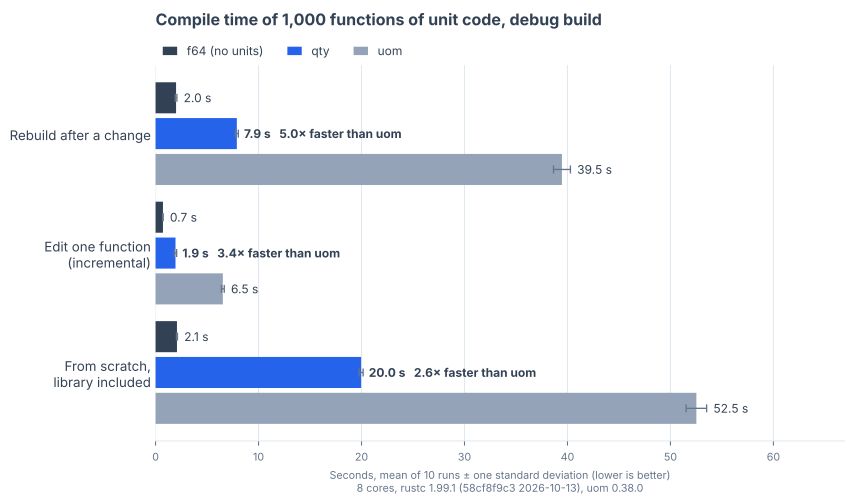
| 1,000 functions | f64 |
qty | uom |
|---|---|---|---|
Rebuild, cargo check |
1.6 s | 6.3 s | 27.9 s |
| Rebuild, debug build | 2.0 s | 7.9 s | 39.5 s |
Edit one function, cargo check |
0.5 s | 1.4 s | 1.4 s |
| Edit one function, debug build | 0.7 s | 1.9 s | 6.5 s |
| From scratch, debug build | 2.1 s | 20.0 s | 52.5 s |
Each function contains the kind of arithmetic, unit literals and
conversions you find in everyday code. Both libraries are built with every
quantity and f64 storage. This program only needs qty's core quantities,
and with just those, qty builds from scratch in 10.9 s. The times are the
mean of 10 runs on 8 cores with rustc 1.99. The raw data is in
docs/compile-times.json,
and scripts/compile_time.py
runs the same measurement on your machine.
Each quantity has a from_ and an as_ method per unit, and new and
convert_to for units chosen at runtime:
use qty::*;

let tyre = Pressure::from_bars(2.4);
assert!((tyre.as_pounds_force_per_square_inch() - 34.8).abs() < 0.1);
assert_eq!(Pressure::new(2.4, PressureUnit::Bar), tyre);
* and / work between any two quantities, and the result has the
dimensions of the product or quotient. Intermediate steps don't need a type
of their own, and at run time the code is the same arithmetic as on plain
floats:
use qty::*;
use qty::constants::GRAVITATIONAL_CONSTANT as G;

let force: Force = Mass::from_kilograms(1200.0) * Acceleration::from_meters_per_second_squared(2.0);
assert_eq!(force, Force::from_newtons(2400.0));
let energy: Energy = Power::from_kilowatts(3.0) * Duration::from_hours(2.0);
assert!((energy.as_kilowatt_hours() - 6.0).abs() < 1e-12);

let (earth, person) = (Mass::from_kilograms(5.972e24), Mass::from_kilograms(70.0));
let r = Length::from_kilometers(6371.0);
let weight: Force = G * earth * person / (r * r);
assert_eq!(format!("{weight:.0}"), "687 N");

let v = Speed::from_meters_per_second(3.0);
let energy: Energy = 0.5 * person * v.powi::<2>();
assert_eq!(energy.as_joules(), 315.0);
Sometimes several quantities share the same dimensions. Then the relations
between quantities decide: power over angular speed is a Torque, and force
times length is an Energy. Otherwise you get the more common one, so an
Energy rather than a Torque, and a Frequency rather than a
RotationalSpeed. When no quantity has the dimensions of a result, as with
person * person, you get a
formula::Expr.
It keeps multiplying, prints in SI units and converts with into().
.powi::<N>() follows the same rules, so side.powi::<2>() is an Area.
Adding a length to a duration is a compile error, and so is asking for the
wrong type: let f: Force = mass * speed reports that it found an
Impulse. Operations that only make sense for some quantities only exist
on those. Area::sqrt gives a Length, and Angle has sin and cos.
qty! writes a quantity as a number followed by a unit. The unit is
checked at compile time, even by cargo check. The result is whatever
quantity the surrounding code expects, whether that comes from a typed
let, a function argument, or the other side of a + or ==:
use qty::*;

let g: Acceleration = qty!(9.81 m/s^2);
let trip = Length::from_kilometers(42.0) + qty!(195 m);
assert_eq!(trip, qty!(42.195 km));

let rise: TemperatureDelta = qty!(5 "°C"); // symbols that aren't Rust tokens
let fall: Length = formula!(0.5 * qty!(9.81 m/s^2) * qty!(2 s).powi::<2>());
assert_eq!(fall.as_meters(), 19.62);
Like parse, it needs to know the target type. On a line of its own,
write let g: Acceleration = qty!(9.81 m/s^2), not
let g = qty!(9.81 m/s^2). A misspelt unit doesn't compile, and neither
does one with the wrong dimensions, such as
let g: Acceleration = qty!(9.81 m/s). A literal is rounded exactly like
the matching from_ method, so qty!(12 ft) is Length::from_feet(12.0)
down to the last bit. Units are constants that carry their dimensions and
conversions in their types, so a literal costs about as much to compile as
a from_ call.
The operators cover most formulas. formula! does the same arithmetic and
then converts the result to the type you ask for. That helps in the cases
the operators don't handle:
- The target isn't the quantity the dimensions pick.
force * leveris anEnergy, butlet t: Torque = formula!(force * lever)gives a torque. - Plain numbers work with every storage type.
formula!(0.5 * m * v * v)also works withf32, while the operators only acceptf64numbers on the left. .sqrt(),.cbrt()and.powi::<N>()work on any intermediate step, and errors name the dimensions in SI base units.
use qty::*;
use qty::constants::GRAVITATIONAL_CONSTANT as G;

let (m, r) = (Mass::from_kilograms(5.972e24), Length::from_kilometers(6371.0));
let escape: Speed = formula!((2.0 * G * m / r).sqrt());
assert_eq!(format!("{:.1}", escape.in_unit(SpeedUnit::KilometerPerSecond)), "11.2 km/s");

# #[cfg(feature = "mechanics")] {
let (force, lever) = (Force::from_newtons(20.0), Length::from_meters(0.5));
let t: Torque = formula!(force * lever);
assert_eq!(t.as_newton_meters(), 10.0);
# }
If a formula's dimensions don't match the target, cargo check fails. For
an energy, kg·m²·s⁻², it says
this formula gives `(kg, m<2>, s<-2>)`, not a `Force` . At run time the
code is the same as the arithmetic on plain floats. The physical constants
are in qty::constants.
expr! computes a formula and keeps the
Expr, even when
a quantity with those dimensions exists:
use qty::*;

let (m, v) = (Mass::from_kilograms(70.0), Speed::from_meters_per_second(3.0));
assert_eq!(expr!(m * v * v).to_string(), "630 kg·m²/s²");Quantities print in their base unit, or in any unit you ask for. Parsing accepts abbreviations, unit names and equivalent expressions:
use qty::*;

let d = Length::from_meters(1234.5);
assert_eq!(d.to_string(), "1234.5 m");
assert_eq!(format!("{:.1}", d.in_unit(LengthUnit::Kilometer)), "1.2 km");
assert_eq!(Length::from_meters(0.0025).auto_unit().to_string(), "2.5 mm");
assert_eq!(Force::from_newtons(1234.5).auto_unit().significant(3).to_string(), "1.23 kN");

assert_eq!("5 km".parse::<Length>(), Ok(Length::from_kilometers(5.0)));
assert_eq!("5 kilometres".parse::<Length>(), Ok(Length::from_kilometers(5.0)));
assert_eq!("3 kg*m/s^2".parse::<Force>(), Ok(Force::from_newtons(3.0)));
With the serde feature, quantities serialize as plain numbers in their
base unit. With #[serde(with = "qty::serde_str")] they read and write text
such as "30 s" or "60 km/h" instead, which is handy for configuration
files. Quantities implement FromStr, so they also work as command-line
arguments. With clap's derive, a field distance: Length accepts
--distance "12 km" and rejects "12 kg" with an error.
A temperature is a point on a scale, so you can't add two temperatures.
Subtracting them gives a TemperatureDelta, which you can add:
use qty::*;

let morning = Temperature::from_degrees_celsius(12.0);
let noon = Temperature::from_degrees_celsius(20.0);
let rise: TemperatureDelta = noon - morning;
assert!((rise.as_degrees_fahrenheit() - 14.4).abs() < 1e-12);
assert!((morning + rise).approx_eq_rel(noon, 1e-12));
Decibel levels (dBm, dBV) work the same way.
Quantities store an f64 unless you choose something else: Length<f32>,
Mass<i64>, complex numbers, decimals or rationals (behind features), or
your own type through the Number and Float traits. With decimals and
rationals, conversions are exact, including fractions such as km/h to m/s
(5/18):
# #[cfg(feature = "num-rational")] {
use num_rational::Ratio;
use qty::*;

let limit = Speed::from_kilometers_per_hour(Ratio::<i64>::from_integer(50));
assert_eq!(limit.as_meters_per_second(), Ratio::new(125, 9));
assert_eq!(Length::from_feet(Ratio::from_integer(1)).as_meters(), Ratio::new(381, 1250));
# }
With f32 and f64, a conversion takes one or two operations and no
division on targets with an FMA instruction. That's every aarch64 target,
and x86-64 with -C target-cpu=x86-64-v3 or native. The result is then
correctly rounded, so Length::from_feet(12.0) is exactly 3.6576 m. On other
targets it multiplies or divides once by the rounded constant, which stays
within one ulp.
Complex storage is useful for AC circuits. A current phasor times a complex
impedance, ElectricCurrent<Complex64> * ElectricResistance<Complex64>,
gives the voltage phasor.
You can add units that UnitsNet doesn't have in your own crate:
use qty::*;

custom_unit! {
    /// The furlong: 220 yards.
    pub struct Furlong for Length {
        abbreviation: "fur",
        singular: "Furlong",
        plural: "Furlongs",
        factor: 201.168, // metres in one furlong
    }
}

let race = Length::new(5.0, Furlong);
assert_eq!(format!("{:.2}", race.in_unit(LengthUnit::Kilometer)), "1.01 km");
You can also add whole quantities, with their own units:
use qty::*;

custom_quantity! {
    /// Printed paper, counted in sheets.
    pub struct Paper;

    pub enum PaperUnit {
        Sheet: "sh",          // the base unit
        Quire: "qr" = 25.0,   // sheets in a quire
        Ream: "rm" = 500.0,
    }
}

let order = Paper::new(3.0, PaperUnit::Ream) + "2 quires".parse::<Paper>()?;
assert_eq!(format!("{:.1}", order.in_unit(PaperUnit::Ream)), "3.1 rm");
# Ok::<(), ParseError>(())
A custom quantity can also declare its physical dimensions, like
dimensions { mass: 1, length: -2 }. Unit expressions such as "80 g/m^2"
then parse as that quantity, it works in formula!, and relation! can
connect it to other quantities. The conversion factor is computed at compile
time, and a relation whose dimensions don't add up doesn't compile:
use qty::*;

custom_quantity! {
    /// The weight of paper per area.
    pub struct Grammage;
    dimensions { mass: 1, length: -2 }

    pub enum GrammageUnit {
        GramPerSquareMeter: "g/m²" (plural "GramsPerSquareMeter"),
    }
}

relation!(Grammage * Area = Mass);

let ream: Mass = "80 g/m^2".parse::<Grammage>()? * Area::from_square_meters(31.25);
assert_eq!(format!("{:.1}", ream.in_unit(MassUnit::Kilogram)), "2.5 kg");
# Ok::<(), ParseError>(())With the fixed feature, Fixed<U, I> counts whole units of U in an
integer, which is what most sensors and file formats produce. Exact
operations just work, and anything that would need rounding asks you how to
round:
# #[cfg(feature = "fixed")] {
use qty::*;
use qty::unit::length::{Meter, Millimeter};
use qty::unit::temperature::{DegreeCelsius, MillidegreeCelsius};

let gap = Fixed::<Millimeter>::round_from(Length::from_meters(0.0125), Rounding::NearestTiesEven).unwrap();
assert_eq!(gap.count(), 12);
assert_eq!(gap + Fixed::<Meter>::new(1), Fixed::<Millimeter>::new(1_012));
let rounded = Fixed::<Millimeter>::new(1_500).to_unit_rounded::<Meter>(Rounding::Ceil).unwrap();
assert_eq!(rounded.count(), 2);

let reading = Fixed::<MillidegreeCelsius, i32>::new(21_375);
assert!(reading > Fixed::<DegreeCelsius, i32>::new(21));
assert_eq!(reading.display_in::<DegreeCelsius>().to_string(), "21.375 °C");
# }
Mixing units where the result wouldn't be exact, such as
Fixed<Meter> + Fixed<Millimeter>, doesn't compile. Without the feature you
still have integer storage in the base unit (Length<i64>) and
round_from.
Vector2<Q>andVector3<Q>, withdot,crossandnormfollowing the same rules: a vector of lengths divided by a duration is a vector of speeds.Uncertain, a number type that carries a standard uncertainty through every calculation: 100 ± 0.5 m divided by 9.58 ± 0.01 s prints as37.6 ± 0.2 km/h.AnyQuantity(featuredynamic), for values whose kind is only known at runtime:"1.5 km".parse::<AnyQuantity>()is a length.- Metadata for every quantity and unit (
Length::INFO,unit.info()): names, abbreviations and dimensions.
| Feature | Default | |
|---|---|---|
std |
yes | Math functions (sqrt, hypot, trigonometry) |
libm |
The same math without std |
|
full |
yes | All quantity groups below |
mechanics, fluids, electrical, thermal, chemistry, light, radiation, information, misc |
through full |
The quantities of each group |
serde |
Serialization | |
fixed |
Fixed integer counts in any unit |
|
dynamic |
AnyQuantity and friends |
|
approx |
approx traits, for assert_relative_eq! |
|
bytemuck |
Zero-copy casts to and from bytes | |
defmt |
Logging on embedded targets | |
chrono, time |
Conversions with their duration types | |
schemars |
JSON schemas | |
num-complex |
Complex storage, Length<Complex<f64>> |
|
rust_decimal |
Decimal storage, Length<Decimal> |
|
num-rational |
Rational storage, Length<Ratio<i64>> |
The 18 core quantities (length, mass, duration, speed, force, energy,
pressure, temperature, angle and a few more) are always available. Building
only those takes about a quarter of the time full takes, so if you only
need a few groups, list them:
qty = { version = "0.5", default-features = false, features = ["std", "electrical"] }Without default features the crate is no_std and never allocates. Add
libm for the math functions. No feature is required, and the default
features pull in no dependencies.
The minimum supported Rust version is 1.82.
The files under src/units/, src/unit.rs, src/cross_type.rs,
src/any.rs and tests/units/ are generated from the UnitsNet definitions
at a pinned commit, and CI checks that they are up to date:
./scripts/download.sh --current
cargo run -p codegen
The generated tests check every unit against the upstream formulas. Property
tests compare the integer arithmetic with exact rational arithmetic, and two
fuzz targets cover parsing and Fixed (see fuzz/README.md). The examples
in examples/ run in CI.
MIT, see LICENSE. The unit definitions and descriptions come
from UnitsNet by Andreas Gullberg
Larsen and contributors, under the MIT No Attribution license.