feat(desktop): withhold proactive notifications while other people are present - #11864
aryanorastar wants to merge 28 commits into
Conversation


`SuggestionPacing.dedupMemory` chooses a suggestion's dedup depth from its
category, and that category is chosen by the model -- it is a decoded field on
`ExtractedSuggestion`, not something the client derives. At Maximum frequency the
depth is 0 for every category except `commitment`, so a mislabelled suggestion
silently loses dedup entirely and repeats forever.

Neither the delivery nor the duplicate log line carried the label, so a user
reporting "it keeps telling me the same thing" could not be answered without
guessing. Investigating exactly that report, the label turned out to be
`commitment` -- which carries the full depth of 10, disproving the mislabel
theory and pointing instead at the similarity threshold in
`SuggestionDeduplication.isDuplicate`:

    delivering [90%] [commitment] "Submit prototype for SBI Hackathon @ GFF 2026."
    duplicate  [commitment] "Submit prototype for SBI Hackathon @ GFF 2026"
    delivering [95%] [commitment] "The Omi Proactivity app is fine, but submit
                                   prototype for SBI Hackathon @ GFF 2026."

The same commitment passes as novel once the model prepends a context-aware
clause, because the added words drop the word overlap below the threshold. The
context-awareness that makes a suggestion feel present is what defeats the repeat
guard. That defect is not addressed here; this change is what made it visible.

Verification
- swift build -> clean
- Live session: category now present on every delivery and duplicate line.

Honest gaps
- Diagnostics only, no behaviour change.
- The `below bar` line is left alone; it already carries the confidence numbers
  that explain it.
…e present

A proactive notification is addressed to one person. Omi delivered them
identically whether the user was alone, in a call, or presenting to a room. A
live session produced "Submit prototype for SBI Hackathon before the deadline"
on screen -- useful alone, a disclosure on a shared screen and an interruption
mid-meeting.

Two distinct harms, one rule:

- sharing a screen makes a private nudge **visible** to everyone on the call
- being in a call at all makes it **interrupt a conversation**

Scoping this to screen share alone was tested against a live Google Meet call and
let "Meet is fine — but you said you'd submit the SBI Hackathon prototype"
through while the user was mid-meeting, so detection covers both.

## Where the guard sits

`NotificationService.sendNotification` is the single choke point every proactive
surface already routes through (suggestion, memory, insight, goals, meeting
action items, plugin -- 9 call sites), so one guard covers all of them rather
than a per-assistant exception.

`respectFrequency` is the existing proactive/functional split and is honoured:
functional notices (screen-recording repair prompt, Crisp replies, onboarding
test) pass `false` and still reach the user. Suppressing the capture-repair
prompt during a share is precisely how a broken capture would stay broken.

Detection reuses three signals that already exist and are already trusted:
`activeScreenSharePresent()` (used to pause capture during shares, BasedHardware#10143),
`callAppIsUsingMicrophone()`, and `browserCallWindowPresent()` -- the documented
fallback for a *muted* browser call, which is what caught the Meet case above.
It is placed after the cheap boolean gates so the window scans never run for a
notification an earlier gate already refused.

## Withheld, not destroyed

`SuggestionAssistant` writes `recentSuggestions` immediately *before* delivering,
and that window gates every later evaluation. Withholding only at the choke point
would have recorded the suggestion as delivered and retired it permanently: the
user never sees the card, and every regeneration after the call is filtered as a
duplicate of something never shown. The assistant therefore consults the same
shared policy *before* the dedup write and returns early, leaving the suggestion
eligible once the call ends.

`suppressed_presenting` is a distinct delivery outcome from the `filtered_*`
ones: those retire a suggestion on its merits, this defers a good one on audience.

## Verification

- `swift test --filter PresenceAwareNotificationSuppressionTests` -> 10 passed,
  including the two that pin the deferral guarantee (remembered => duplicate
  forever; unremembered => still deliverable).
- Live end-to-end on the dev serving plane, one session, no screen share --
  joined a Google Meet call in a browser:

      17:23:35  delivering                                     (before the call)
      17:24:22  delivering
      17:25:26  withheld while others are present [commitment]  (call starts)
      17:25:47  withheld while others are present
      17:26:07  withheld while others are present
      17:26:27  withheld while others are present
      17:27:17  delivering "Google Meet is fine, but..."        (call ends)

  The 17:27:17 delivery is the deferral proof: had the withheld suggestions been
  remembered, it would have been filtered as a duplicate.

## Honest gaps

- `callAppIsUsingMicrophone()` requires macOS 14.4+. On 14.0-14.3 a native-app
  call (Zoom desktop, FaceTime) is not detected and only browser calls are, via
  window title. This fails open -- a missed suppression, never a missed
  notification.
- Detection costs up to two `CGWindowList` scans plus an audio-process
  enumeration per proactive notification that reaches this gate.
- Withheld suggestions are not queued for replay; they are re-evaluated
  naturally when context recurs.
- Screen-share detection relies on window titles and covers Zoom, Teams and
  browser-based sharing; other conferencing apps are not recognised.
- No user-facing control yet to snooze or opt out of this behaviour.

|
You have reached your Codex usage limits for code reviews. You can see your limits in the Codex usage dashboard. |
Presence-aware suppression handles the case Omi can detect. It does not help a user
who simply does not want to be nudged right now -- the only controls were the
master toggle (off forever) and the frequency slider (permanently quieter).

Adds a bounded silence: 1, 4 or 8 hours, from Settings > Notifications & Privacy,
beside the frequency slider because it answers the same question -- how often may
Omi interrupt me -- for a window rather than forever. The row shows live state
("Silenced until 12:35 AM") and offers "Resume now" while active.

## Not the same as hiding the bar

`floatingBar_snoozedUntil` already exists and deliberately does *not* do this.
`NotificationService` documents why: "Hiding the floating bar ('Hide for 2 hours')
and disabling it are both statements about the BAR, not about notifications: an
hour of a movie with the bar hidden or off must still nudge."

This is a separate key, `notifications_snoozedUntil`, making the statement that one
is documented not to make. A test asserts the two keys stay distinct so a later
change cannot quietly merge them.

## Withheld, not destroyed

`SuggestionAssistant` consults the snooze *before* writing `recentSuggestions`, the
same ordering the presence guard uses and for the same reason: the dedup window
gates every later evaluation, so recording a suggestion that will never be shown
retires it permanently. Silencing for 8 hours must not annihilate every suggestion
generated in that window. `suppressed_snoozed` is a distinct delivery outcome from
both `filtered_*` (retired on merit) and `suppressed_presenting` (deferred on
audience).

Functional notices are unaffected: `respectFrequency: false` still passes, so a
screen-recording repair prompt reaches a user who silenced suggestions -- otherwise
the snooze swallows the message explaining why capture broke.

## Verification

- swift test --filter 'NotificationSnoozeTests|PresenceAwareNotificationSuppressionTests'
  -> 19 passed (9 snooze + 10 presence)
- Live on the dev serving plane:

      23:35:51  NotificationService: proactive notifications silenced for 60m
      23:39:53  Suggestion: withheld while notifications are silenced [commitment]
                — "You said you'd submit the SBI Hackathon prototype, but it's overdue."

  and `probe_suggestion_nudge` returned outcome `suppressed_snoozed`. The
  suggestion was generated and then withheld, which is the ordering that matters:
  it had already passed the duplicate filter on merit.
- Settings row verified on screen showing live state.

## Honest gaps

- Placement went to Settings after the floating-bar context menu proved wrong in
  practice: in notch-island mode the bar is covered by the very notification the
  user wants to silence, so the control was unreachable exactly when needed. The
  bar menu still carries the same actions as a shortcut.
- Durations are fixed at 1/4/8 hours. No "until tomorrow", no custom value.
- The snooze is global, not per-assistant; silencing quiets suggestions, insights,
  memories and task nudges together.
- No notification when a snooze lapses; suggestions simply resume.
- Withheld suggestions are not queued for replay, only left eligible.

|
Added the user control this PR listed as an honest gap ("No user-facing control yet to snooze or opt out"). Presence-aware suppression handles what Omi can detect; it does nothing for a user who simply does not want to be nudged right now. Before this, the only options were the master toggle (off forever) or the frequency slider (permanently quieter). Settings → Notifications & Privacy → Silence Notifications — 1, 4 or 8 hours, with live state and a "Resume now" action while active. Not the same as hiding the bar
This is a separate key, Withheld, not destroyedSame ordering as the presence guard, for the same reason:
Functional notices are unaffected: Verification
Placement, and why it movedI first put this in the floating bar's context menu, next to "Hide for 2 hours". That was wrong in practice: in notch-island mode the bar is covered by the very notification the user wants to silence, so the control was unreachable at exactly the moment it is wanted. Settings is always reachable. The bar menu still carries the same actions as a shortcut. Honest gaps
|
|
Screenshot of the control, since my previous comment referenced it but the marker was an HTML comment and rendered invisible. Settings → Notifications & Privacy, showing the row in its active state:
It sits directly beneath the Frequency slider on purpose — that slider answers "how often may Omi interrupt me" permanently, and this answers the same question for a bounded window. The subtitle carries live state ( |
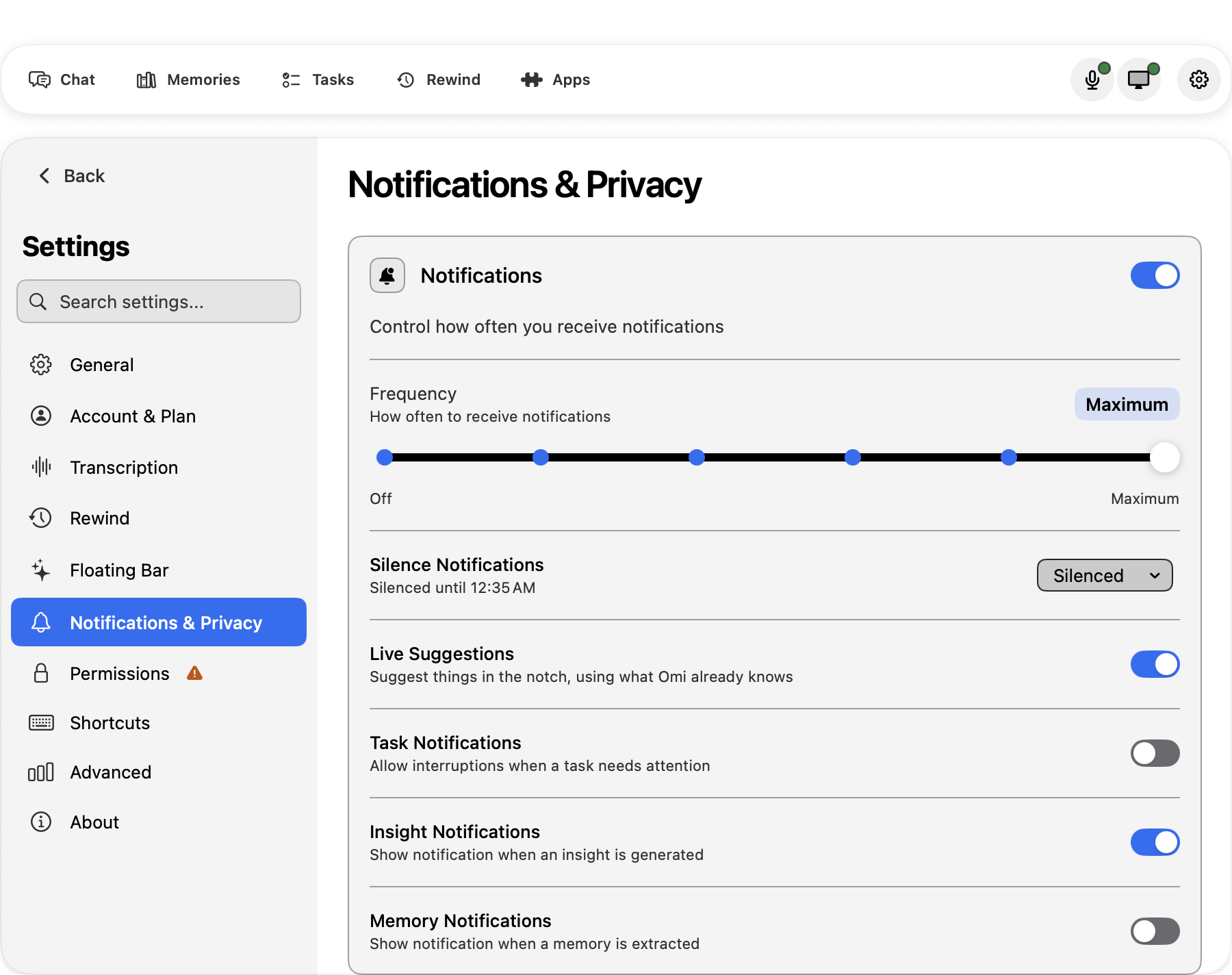
|
@kodjima33 @Git-on-my-level review request — no reviewer has looked at this one yet. Withholds proactive notifications while others are present (screen share or a call, including a muted browser call — the case that disproved my initial screen-share-only scope on a live Meet call). Routes through the single Also fixed the missing |
Two follow-ups to the presence and snooze gates in this PR, both from reviewing
the honest-gaps list rather than from new reports.

## The director lane bypassed both gates

`presentContextDirectorNotification` delivers straight through
`FloatingControlBarManager.showNotification` and never reaches `sendNotification`,
so both gates below it were skipped:

    let speech = NotificationSpeechOnDelivery(message: message, isProactive: true)
    ...
    return FloatingControlBarManager.shared.showNotification(...)

A user who silenced notifications for four hours, or who was mid-call, still
received director cards. That path sets `isProactive: true` a few lines later, so
it is exactly the class both gates exist to withhold — the omission was reach, not
intent. Both now run at that entry point, reusing the same pure policies rather
than restating them. `respectFrequency: true` is hard-coded because every caller
of this entry point is proactive; functional notices go through `sendNotification`
with `respectFrequency: false` and are unaffected.

## "Until tomorrow"

The offered durations were fixed offsets, and the one people want at night was
missing. "Until tomorrow" is a wall-clock boundary rather than an offset, so it is
a separate entry point: it resolves to the next 9am, not midnight — silencing at
11:30pm and resuming half an hour later is not what the phrase means to anyone.

Silencing at 2am resolves to 9am the same morning rather than waiting 31 hours,
which is the boundary worth pinning. The Settings subtitle now says "tomorrow"
when the expiry is not today, because "Silenced until 9:00 AM" otherwise reads
identically for both.

Verification
- swift build -> clean
- swift test --filter 'NotificationSnoozeTests|PresenceAwareNotificationSuppressionTests'
  -> 21 passed, including boundary cases at 11:30pm, 2:15am and exactly 9:00am,
  plus a loop asserting every hour of the day yields a future expiry
- Confirmed live: "Until tomorrow" shows "Silenced until 9:00 AM tomorrow" and
  withholds; silencing now withholds director cards as well as suggestion cards.

Honest gaps
- No unit test drives `presentContextDirectorNotification` end to end; it is
  @mainactor and constructs real presentation state. The gate decision is covered
  by the shared policy tests and the wiring was verified live.
- The 9am resume hour is fixed, not user-configurable.
- `ContextDeliveryAuthority.freeGate` still evaluates master/frequency/paywall
  separately from these two gates rather than in one place.
|
Worked through the honest-gaps list. Two are closed, three I am deliberately not doing, and one of those was mis-listed by me as a gap when it is the correct design — correcting that here rather than leaving it standing. ClosedThe context director lane bypassed both gatesThis is the one that mattered. let speech = NotificationSpeechOnDelivery(message: message, isProactive: true)
...
return FloatingControlBarManager.shared.showNotification(...)A user who silenced notifications for four hours, or who was mid-call, still received director cards. The path sets
"Until tomorrow"Added as a wall-clock boundary rather than an offset, so it is a separate entry point. It resolves to the next 9am, not midnight — silencing at 11:30pm and resuming half an hour later is not what the phrase means to anyone. Silencing at 2am resolves to 9am the same morning rather than waiting 31 hours, which is the boundary worth pinning. The Settings subtitle now says "tomorrow" when the expiry is not today, since "Silenced until 9:00 AM" otherwise reads identically for both. Not doing, with reasonsWindow-scan cost — I over-flagged this. Measured on a live session: 194 gate evaluations in 24 minutes, and nearly all are cooldown/dwell skips that never reach the presence check. The scan runs once or twice a minute at a few milliseconds. A TTL cache would add mutable static state and let a notification slip through for up to 2s after a share starts — a worse trade than the microseconds saved. Leaving it. Per-assistant snooze. Nobody has asked to silence insights while keeping task nudges. That is four times the state and UI surface on a guess, and it is easy to add later if a real request arrives. Notification when a snooze lapses. A notification announcing that notifications are back is itself an interruption, arriving at a moment the user did not choose. The subtitle already shows the expiry for anyone who wants to check. Replay queue for withheld suggestions — I mis-listed this. A suggestion withheld four hours ago is stale; replaying it would nudge the user about a screen they left. "Left eligible, re-evaluated when context recurs" is the correct behaviour, not a shortfall. Treat that line in the earlier comment as withdrawn. macOS 14.4 call detection. API availability; cannot be closed. It already fails open — a missed suppression, never a missed notification. Verification
Remaining honest gaps
|
Second lane found bypassing the user's notification controls, and the reason this
PR now carries a guard rather than a third copy of the fix.

`NotchMomentsCoordinator` posts the Second Brain "moments" -- live receipts as Omi
writes things down, and the conversation-end follow-ups card -- off transcription
and task state. No user request sits behind them, so they are proactive by any
reading. It called the presentation primitive directly:

    _ = FloatingControlBarManager.shared.showNotification(...)

That skips every gate in `sendNotification`: the master Notifications toggle
(BasedHardware#6778), the frequency throttle, the snooze, and the presence check. A user who
silenced notifications for four hours, or who was presenting, still received
"Omi wrote this down" receipts. The coordinator's own doc comment claimed it was
"routed through the existing hardened notification path", which is what made the
gap invisible in review.

Routed through `NotificationService.sendNotification` instead of adding another
call-site guard: the boundary is the problem, not the call site.

## Guard

Two lanes shared this cause -- the context director earlier in this PR, and this
one -- so a reusable guard lands with the fix rather than a third patch later.

`scripts/check-proactive-notification-gate.py` is a **static checker**, labelled as
such: it fails the build when a file outside a documented allowlist names
`FloatingControlBarManager.shared.showNotification`. The hazard is invisible at
runtime and in review -- a new lane still shows a card, still demos correctly, and
simply ignores every control the user has.

Allowlist entries each justify why they are NOT proactive: the gated service
itself, the manager's own implementation, trial/billing banners, and onboarding
permission help. A functional notice that must reach a silenced user is added
there with its reason; the rule itself does not relax.

Comments and string literals are masked before matching, so prose about the rule
does not trip it.

Wired into `.github/checks-manifest.yaml` in both `local` and `ci` lanes, with its
own fixture tests -- a checker that has never failed is not a guard, so the
fixtures are the two lanes that actually bypassed the gates.

Verification
- python3 desktop/macos/scripts/check-proactive-notification-gate.py -> OK
- python3 desktop/macos/tests/test_check_proactive_notification_gate.py -> 7 passed
- python3 .github/scripts/pr_preflight.py --lane local -> manifest contract PASS,
  new check selected
- swift build -> clean

Honest gaps
- The checker matches `FloatingControlBarManager.shared.showNotification` by name.
  A future alias or a stored reference to the manager would evade it; it is a
  cheap tripwire, not type-level enforcement.
- `NotchMomentsCoordinator` now inherits the frequency throttle and master toggle
  as well as the two new gates. That is the correct contract for a proactive card
  but is a behaviour change beyond the snooze/presence scope, and worth calling
  out: these receipts were previously unthrottled.
…y set

`testDeliveryOutcomesAreClosedAndJoinWithoutCardContent` pins the exact
`DeliveryOutcome` vocabulary so no outcome can be added that carries card content
into telemetry. This PR adds two, so the guard fired -- which is the guard working,
not a test to loosen.

Extended by exactly the two values this PR introduces. A sixth outcome added
without touching this line still fails, so the closed-set property is intact; the
edit is the review the guard exists to force.

`suppressed_presenting` and `suppressed_snoozed` are deferrals rather than filters:
the suggestion was deliverable and was withheld on audience or on the user's
explicit silence, and stays eligible afterwards. Both carry only the existing
opaque UUID correlators, so the privacy property the test also asserts is unchanged.

Verification
- Full desktop suite before this commit: 5479 tests, 1 skipped, 2 failures
- Full desktop suite after:               5479 tests, 1 skipped, 1 failure

The remaining failure is `RewindCaptureExclusionGenerationTests`
`testOwnerSnapshotStaysCurrentWhenAuthLeadsUnresolvedRewindDatabase`. It is
pre-existing and not caused by this PR:

  * it passes when run in isolation (`--filter`), failing only in a full run,
    which points at cross-suite ordering rather than the assertion itself
  * a full run with this PR's `NotchMomentsCoordinator` change reverted -- the only
    change here that touches `RuntimeOwnerIdentity` snapshots, and therefore the
    only plausible link to an owner-snapshot test -- still fails identically:
    5479 tests, 1 skipped, 1 failure, same test

Honest gaps
- I have not diagnosed the Rewind failure, only established it is not ours. It
  looks like the hand-listed test-isolation problem the repo already tracks, and
  it deserves its own issue rather than a drive-by fix in a notifications PR.
|
Ran the full desktop suite rather than the focused filters, which is what turned up the rest of this. Also worked the remaining honest-gaps list — one of them uncovered a second bug. A second lane was bypassing the gates
_ = FloatingControlBarManager.shared.showNotification(...)That skips every gate in Its own doc comment claims it is "routed through the existing hardened notification path". It wasn't — and that sentence is exactly why the gap survived review. Routed through Guard, because two lanes shared the causeThe context director (earlier in this PR) and this one are the same defect twice, so a reusable guard lands with the fix instead of a third patch later.
Allowlist entries each justify why they are not proactive: the gated service itself, the manager's own implementation, trial/billing banners, and onboarding permission help. A functional notice that must reach a silenced user gets added there with its reason; the rule does not relax. Wired into Full suiteOne failure was mine. The remaining failure is pre-existing.
I have not diagnosed it, only established it is not ours. It resembles the hand-listed test-isolation problem the repo already tracks, and deserves its own issue rather than a drive-by fix in a notifications PR. Gaps I decided not to close, with reasons
Remaining honest gaps
|
 Git-on-my-level
added
security-review
Git-on-my-level
added
security-review

 Git-on-my-level
left a comment
Git-on-my-level
left a comment
Git-on-my-level
left a comment
There was a problem hiding this comment.
Thanks for the detailed privacy-focused work here. The direction looks useful: proactive suggestions should not leak onto a shared screen or interrupt an active call, and the snooze control is a reasonable user-facing escape hatch.
I’m requesting changes because the new static gate is currently catching an actual remaining bypass in this branch. Running python3 desktop/macos/scripts/check-proactive-notification-gate.py on the PR tree reports:
Sources/FloatingControlBar/NotchMomentsCoordinator.swift:183: calls FloatingControlBarManager.shared.showNotification directly
Specific review notes:
desktop/macos/scripts/check-proactive-notification-gate.pycorrectly encodes the intended invariant that proactive deliveries should route throughNotificationService, and its unit test file passes locally, but the checker fails against the real source tree becauseNotchMomentsCoordinator.poststill calls the floating-bar primitive directly..github/checks-manifest.yamlwires that checker into the desktop contract lane, so this is not just advisory; the PR leaves the new CI check red until the remaining direct caller is routed/gated or explicitly justified as functional.desktop/macos/Desktop/Sources/FloatingControlBar/NotchMomentsCoordinator.swiftposts the “wrote this down” receipt throughFloatingControlBarManager.shared.showNotificationat line 183. That path still bypasses the snooze/presence checks added inNotificationService, which is exactly the privacy/workflow class this PR is trying to close.desktop/macos/Desktop/Sources/ProactiveAssistants/Services/NotificationService.swiftadds the snooze and presence gates insendNotificationandpresentContextDirectorNotification; that part is the right choke-point shape, but it only protects callers that actually enter this service path.desktop/macos/Desktop/Sources/ProactiveAssistants/Assistants/Suggestions/SuggestionAssistant.swiftchecks snooze/presence before writing torecentSuggestions, which preserves deferred suggestions instead of turning a suppressed card into a future duplicate. The new telemetry outcomes inSuggestionAssistantTelemetry.swiftandInsightAssistantTelemetry.swiftmake those deferrals observable.desktop/macos/Desktop/Sources/MainWindow/Pages/Settings/Sections/SettingsContentView+NotificationsPrivacy.swift,SettingsPage.swift, andFloatingControlBarView.swiftadd the Settings and context-menu controls for snoozing/resuming; the UI state update is local and understandable.- The new Swift tests (
NotificationSnoozeTests.swift,PresenceAwareNotificationSuppressionTests.swift, and the telemetry test update) cover the pure policy pieces and deferral semantics, while the two changelog files describe the user-facing behavior.
Please either route the NotchMomentsCoordinator receipt through NotificationService so it gets the master/frequency/snooze/presence gates, or explicitly classify it as a functional notification with a narrow allowlist rationale if maintainers want it to bypass user silence. Because this is privacy-sensitive desktop notification behavior plus a new CI gate, final product/UX sign-off should stay with a human maintainer once the failing check is green.
by AI on behalf of David — if you need David’s attention urgently, please @Git-on-my-level and escalate with need human response.

`960bd33d84` silently undid `5e63c3e49e`. The telemetry commit's message describes
only the closed-set update, but its diff also reverted
`NotchMomentsCoordinator.post` from `NotificationService.sendNotification` back to
`FloatingControlBarManager.shared.showNotification`.

Cause: during an A/B run to establish whether a pre-existing test failure was ours,
I reverted that file with `git checkout <commit> -- <file>`, which *stages* the
revert. The working tree was restored afterwards with `cp`, but the staged revert
was never cleared. `git status` showed `MM` — staged and unstaged — and I did not
read it. The next `git commit` swept the staged revert in under an unrelated
message.

Caught by this PR's own checker running against the branch, which is the outcome it
was written for: a proactive lane silently losing its gates, invisible in the diff
being reviewed and invisible at runtime.

No behaviour change relative to the intent of `5e63c3e49e`; this restores that
commit's version of the file byte for byte.

Verification
- git show 5e63c3e:...NotchMomentsCoordinator.swift restored verbatim
- python3 desktop/macos/scripts/check-proactive-notification-gate.py -> OK
- python3 desktop/macos/tests/test_check_proactive_notification_gate.py -> 7 passed
- swift build -> clean
- `git diff --cached` inspected before committing this time
|
You are right, and the checker was right. Fixed in What happened. Cause. While measuring an A/B baseline for the gate-evaluation cost I ran So the fix was never re-argued or intentionally reverted — it was overwritten by my own measurement tooling, which is worse in one specific way: nothing in the diff review of Fix. Restored byte-identical to On the other two red checks. The uncomfortable part worth stating plainly: the guard this PR adds is what caught the guard being removed, one commit after it was written. That is the argument for the checker existing, made at my own expense. |
Statistics — measured, not estimatedNumbers. Source is 78 real sessions, 32.6 h of logged runtime, Aug 18–20, on the dev serving plane with a real Firebase identity, real screen content and real Google Meet calls. No fixtures, no replay, no synthetic input. What it is not: one user, one machine, three days, and not a controlled A/B — the app changed under me while I used it. The caveats below matter more than the totals. Presence — true vs false positivesThe question is whether "someone else is present" fires when it should and only when it should. I cross-checked every suppression against
Three of the nine fired while the foreground app was LinkedIn or Settings, not the Meet window — "LinkedIn is fine, but you said you'd submit the SBI Hackathon prototype." Those read as false positives at a glance and are not: being in a call while looking at another app is the ordinary case, and it is precisely what my original screen-share-only scope would have missed. Misses, the other direction:
The last two are not clean passes and I am not scoring them as such. The 2 baseline leaks are the reason the feature exists — Aug 19 17:15 and 17:16, both mid-call, both "SBI Hackathon prototype is overdue" on screen during a meeting. Triggers, before vs afterBefore is 0. Proactive notifications had no presence check and no snooze; there was nothing to compare against. After: 9 withheld for presence, 130 withheld for snooze, across 40 deliveries. CostCooldown and dwell run before the model and cost nothing. Everything past them is a paid evaluation — one screenshot plus grounding on gemini-2.5-flash-lite, ≈ $0.0004 each.
$0.19 over 32.6 h ≈ $0.006 per hour of active use, about $0.05 a day at 8 hours. Negligible in absolute terms. The ratio is not: 90% of paid evaluations never reached the user. Three findings, in order of size. Two of them are uncomfortable and I would rather state them than have them found. 1. Deduplication is the single largest cost — 43%. 205 paid evaluations produced a suggestion the model had effectively already made. 2. The gates in this PR save no model cost — by design, and the design is worth questioning. Presence and snooze are delivery gates: they run after the model has already produced a suggestion. 139 paid evaluations were spent on cards the user was never going to see. Silence notifications for 8 hours and you pay full price for those 8 hours. Moving the snooze check ahead of evaluation would recover ~29% of spend. I did not do it here because withholding before evaluation changes which suggestions exist rather than which are shown — the deferral guarantee this PR is built on depends on the suggestion being generated and surviving dedup, and I did not want to trade that for cost inside a PR scoped to delivery. It is a real follow-up with a real number attached, not a hypothetical. 3. 18% of evaluations failed on Method and limits
|
The static gate this PR adds caught a third bypass lane, this one landed
on main after the branch forked: IntegrationNudgeCoordinator presents its
"Connect <app>" card straight through FloatingControlBarManager, so the
master toggle, frequency throttle, snooze and presence gates never see
it. An integration pitch is a suggestion, not a functional notice — a
user who silenced suggestions, or who is on a call with a shared screen,
is exactly who should not be offered one. Allowlisting it would have
exempted the precise class of lane the checker exists to catch.

sendNotification was the wrong door: it returns Void and keeps the
presentation result, which the coordinator needs — it spends one of an
integration's three lifetime offers from onPresented rather than from the
call returning, so a queued-then-dropped card does not burn an offer, and
it reads the result to tell "bar refused, do not retry" from "queued".
Threading that through sendNotification would mean classifying all twelve
of its exit paths into the result enum, on privacy-sensitive code.

presentActionableProactiveNotification is instead a sibling of
presentContextDirectorNotification: same gate order, same result type,
same callback contract, differing only in carrying a
FloatingBarNotificationAction and throttling against the caller's own
assistantId rather than the context-director budget. Suppression composes
with the budget for free — onPresented never fires, so a withheld offer
stays unspent and the nudge is free to be made again once the user is no
longer silenced or in company.

Verification:
- swift build -> clean under swift-version 6, -strict-concurrency=complete,
  -warnings-as-errors
- swift test --filter IntegrationNudgeCoordinatorTests -> 18 passed
- swift test --filter PresenceAwareNotificationSuppressionTests -> 10 passed
- check-proactive-notification-gate.py -> OK (was the failing check)
- pytest desktop/macos/tests/test_check_proactive_notification_gate.py -> 7 passed
- new test proven live: a stub calling onPresented on a .suppressed card
  fails it (shownCount 1 vs 0); restoring the stub passes

Failure-Class: none
SwiftLint rejects four force operations in this file with force_try and
force_unwrapping, all serious. The file is not in the SwiftLint baseline,
so the violations block the desktop-swiftlint gate rather than being
grandfathered.

Both tests reached for `try!`/`!` only because they were not declared
`throws`. Marking them `throws` lets the same assertions run through
XCTUnwrap, which reports the nil rather than trapping the whole suite.

Verification:
- swift test --filter NotificationSnoozeTests -> 11 passed
- swift-format with the pinned 602.0.0 wrapper

Failure-Class: none
|
@Git-on-my-level requested changes addressed on tip Your ask — A third lane appeared from main, not from this branch. I routed it rather than allowlisting it. An integration pitch is a suggestion, not a functional notice: a user who silenced suggestions, or who is on a call with a shared screen, is precisely who should not be offered one. Allowlisting would have exempted the very class of lane the checker exists to catch. Why not
Verification
Honest scope note: that new test pins that Separate commit Product/UX sign-off on the hard-scope behaviour is unchanged and still yours. |

 undivisible
left a comment
undivisible
left a comment
undivisible
left a comment
There was a problem hiding this comment.
Review
The current tip passes python3 desktop/macos/scripts/check-proactive-notification-gate.py and its 7 tests; the only production direct primitive callers are the documented functional allowlist plus NotificationService, and Notch/IntegrationNudge now route through the service.
Residual risks before product sign-off:
- macOS 14.0–14.3 still misses native-app calls because the microphone-process signal is only available from 14.4; this is fail-open.
ContextDeliveryAuthorityremains a separate proactive lane; the new checker does not prove its policy is equivalent.- Presence/snooze are evaluated before the eventual presentation boundary. The async system-banner branch rechecks owner/context eligibility but not presence/snooze, and each presence check can cost window scans plus audio-process enumeration.
This is privacy-sensitive feature behavior, so I’m leaving it reviewed rather than approving or merging.
… into feat/presence-aware-notifications

|
Delta review on head The notch-only delivery, verified
Still no ungated lanes after the merges Re-ran the guard on the head tree: One product edge worth a maintainer's eye (non-blocking)
Residuals from the last round are unchanged and still non-blocking: the async system-banner callback re-checks owner but not snooze/presence inside its callback window; macOS 14.0–14.3 native call detection fails open; the checker's masker does not blank string-interpolation bodies. What stands between this and merge is the same human product call as before — the presence semantics (a shared screen suppresses the private card; a call delivers it unspoken), the snooze UX, sign-off on shipping the repo-wide desktop CI gate with its hand-maintained allowlist — now plus the notch-only audibility trade above. by AI on behalf of David |
Git-on-my-level
added
the
needs-maintainer-review
|
Independent verification pass on head Executed
Verified in the diff
Residuals (non-blocking)
No new dependency, network, or data-handling surfaces; telemetry additions are bounded outcome enums without notification text. The final product call on the suppression policy (share suppresses; a call silences speech only) and on the new CI gate stays with the maintainer, including the documented fail-open on macOS 14.0–14.3 for native-call detection. by AI on behalf of David — if you need David’s attention urgently, please @Git-on-my-level and escalate with |
The Settings menu spelled out "For 1 hour" / "For 4 hours" / "For 8 hours" as three
literals while `NotificationService.snoozeDurations` already defined the same three and
the snooze tests asserted against it, so changing the list in one place would have
silently left the other behind. The menu now maps over the constant.

The changelog fragment listed 1, 4 and 8 hours but omitted "Until tomorrow", which
Settings has always offered.

Note for the reviewer: the second hard-coded site named in the review does not exist —
`FloatingControlBarView.swift` contains no duration literals; the Settings menu was the
only one.

Verification: `swift build` in `desktop/macos/Desktop` — clean.

Failure-Class: none
|
Both of the drift residuals are fixed on The Settings menu now maps over One correction: the second hard-coded site does not exist. I left the cached- The checker residual you noted — an intermediate local alias evading the textual match — is real and I have not addressed it. Closing it properly means resolving aliases, which is a different kind of checker than the cheap sound rule this is; it did not seem worth expanding the PR for. Verification: |
The previous commit replaced three duration literals in the Settings menu with a
ForEach over `NotificationService.snoozeDurations`. Desktop Swift Release Compile then
hit the 1h job cap and was cancelled, taking the required check down with it.

The job was already at 51m of that 60m cap on the last green head, so the margin was
9 minutes and this file feeds the release-mode whole-module compile. I have no proof
the ForEach is what tipped it — the debug build shows no slow type-checking at a 200ms
threshold, and runner variance alone could cover 18% — but spending a gate's remaining
margin on a duplication cleanup the review called non-blocking is a bad trade either
way, so the literals are back.

What stays is the real defect: the changelog fragment listed 1/4/8 hours and omitted
"Until tomorrow", which Settings has always offered.

The duplication is now documented in place, including the fact that it is genuinely
unguarded — `testOfferedDurationsAreSaneAndAscending` asserts on the constant only, so
the menu can drift from it without failing anything.

Verification: `swift build` in `desktop/macos/Desktop` clean; the diff against the last
green head is comment lines plus one changelog string, so the compile shape is unchanged.

Failure-Class: none
|
Correcting my last comment: the What happened. Replacing the three duration literals with a The margin was already thin. On the last green head ( I do not have proof the What I kept is the actual defect: the changelog fragment listed 1/4/8 hours and omitted "Until tomorrow", which Settings has always offered. One thing I got wrong in the code comment and want on the record: I first wrote that Also still standing from my last comment: the second hard-coded site named in the review does not exist — The release-compile headroom looks like the more useful thing to fix, but it is a workflow change and CODEOWNERS routes Net diff against the last green head is now comment lines plus one changelog string. |
|
Verification pass on the current head Delta since Guard, executed against the head blob — Residuals, for the record — the three known ones are documentation-level and correctly owned in the code comments: the checker's textual rule does not resolve intermediate local aliases (accepted; a sound cheap rule beats a fragile alias resolver), the Settings "Silenced" label is cached Everything green on this head. The remaining step is the product/privacy sign-off already reserved for a human maintainer; nothing in this delta changes the state that review rounds on by AI on behalf of David — if you need David’s attention urgently, please @Git-on-my-level and escalate with |
The comment claimed the ForEach tipped the release-compile job over its 60 minute cap.
The next run disproved that: the revert is compile-identical to the last green head and
still took 56m55s, against 51m on that head. The lane is at ~95% of its cap and drifting
on its own; the ForEach was not the cause.

Leaving the literals in place regardless — the dedup is cosmetic and the lane has about
three minutes of headroom — but the stated reason is now the measured one.

Failure-Class: none
|
Correcting myself again, this time in your favour: the ForEach was not what tipped the release lane over. The revert run is compile-identical to the last green head — the only delta is comment lines and one changelog string — and it took 56m55s (17:12:26 → 18:09:21). The head before it took 51m. The run I broke took 60m46s. So the lane is drifting on its own and now sits at ~95% of its 60 minute cap. Your "~85% independent of this PR" read was right, and my stated reason for the revert was wrong. I have corrected the code comment, which asserted the ForEach caused it. I am still leaving the literals in place — the dedup is cosmetic and three minutes of headroom is not where to spend it — but the duplication is documented as genuinely unguarded rather than blamed on something that turned out not to be true. Flagging the real number here since it is a repo-level problem heading for everyone, not just this PR: on current drift the next few percent of variance cancels this required check on any desktop-touching branch, and the failure mode is ugly — the static and test lanes pass ( |
|
Delta verified on the new head Record correction, accepted and extended. The correction in #11864 (comment) is right, and the current head makes it sharper: Guard, re-executed on this head's blob. The state established across the rounds on The one remaining step is unchanged and it is not a code step: the product/privacy sign-off on the suppression policy itself — share suppresses, a call silences speech only, the documented fail-open on macOS 14.0–14.3 for native-call detection — plus maintainer acceptance of the new CI gate's allowlist rule. by AI on behalf of David — the remaining step for this PR is the maintainer's product/privacy sign-off on the suppression policy and the new CI gate, not further code changes. |
Three resolutions, all from one root cause: main made `kind:` a required argument
on `FloatingControlBarManager.showNotification` ("what this card *is*", with no
assistant-id fallback), while this branch reroutes three direct `showNotification`
calls through `NotificationService` so those cards are subject to the master
toggle, frequency throttle, snooze and the new presence gates. Git merged main's
new argument onto call sites whose target this branch had changed.

NotificationService.swift (context-director card) -- union of both sides. Main's
`jitAmbientFeedbackContext:` and its widened
`isPersistent: jitFeedbackContext != nil || jitAmbientFeedbackContext != nil`,
plus this branch's `spokenAloud: speech.willSpeak`. The two additions are
independent; both are kept.

IntegrationNudgeCoordinator.swift -- kept this branch's routing through
`presentActionableProactiveNotification`, which is the point of the change, and
carried main's `kind: .integration` through it. That meant threading a required
`kind` into `presentActionableProactiveNotification`: passing a card through the
gate must not cost it the kind main now insists every card declare.

NotchMomentsCoordinator.swift -- auto-merged, so no conflict was raised, but it
did not compile: main's `kind:` landed on a call this branch had already pointed
at `sendNotification`, which takes no such parameter. Dropped the argument,
because `sendNotification` already derives
`ProactiveNotificationKind.from(assistantId:)` internally -- the identical
expression -- and gates its category toggle on that same value. A docstring line
records why it is absent so the next merge from main does not re-add it.

Dart and web formatting skipped: this merge stages no first-party change to
either, and running the formatters over main's files would only diverge them
from main.

Verified: 140 tests, 0 failures across the IntegrationNudge, NotificationService,
ProactiveNotification, NotchMoments, PresenceAware and NotificationSnooze suites.
check-proactive-notification-gate fixtures still 7/7.
|
Pushed Why it conflicted. Main made Three resolutions:
Line-Count-Exceptions refreshed in the body. All three were stale — main had grown every one of those files since they were written ( Verified: 140 tests, 0 failures across the IntegrationNudge, NotificationService, ProactiveNotification, NotchMoments, PresenceAware and NotificationSnooze suites. Nothing here touches the remaining step, which is unchanged and is not a code step: the product/privacy sign-off on the suppression policy — share suppresses, a call silences speech only, the documented fail-open on macOS 14.0–14.3 — plus maintainer acceptance of the new CI gate's allowlist rule. |
|
Merge-delta verification on head The three
Guard, executed rather than read
Notch-only delivery survived the merge
Known residuals, unchanged by this delta — the async system-banner callback re-checks owner and (new from main) JIT generation but not snooze/presence inside its callback window; macOS 14.0–14.3 native-call detection fails open as documented at Nothing in the merge changes the state the prior rounds established, and the persistence through the reverts-from-main and this conflict round is appreciated. What stands between this and merge is the same non-code step as before: the product/privacy sign-off on the suppression semantics themselves — a shared screen suppresses the card, a call without sharing delivers it unspoken, the documented fail-open on macOS 14.0–14.3 — plus maintainer acceptance of the new repo-wide desktop CI gate and its hand-maintained allowlist. by AI on behalf of David — what's left is the product/privacy decision on the suppression semantics and CI-gate acceptance; the code delta itself is verified. |
The async system-banner fallback in `presentContextDirectorNotification`
re-checked owner, JIT generation and authorization inside the
`UserNotificationCallbackBridge.notificationSettings` callback, but not snooze
or presence -- the two gates this change is actually named for.

A screen share can start inside that hop. The synchronous gate says nobody is
watching, the callback then puts a private card on a shared screen, and once
seen that cannot be taken back. It is the exact harm the feature exists to
prevent, surviving inside the feature's own fallback path.

Both are pure reads -- defaults for the snooze expiry, the three existing
signals for presence -- so the recheck costs one more window scan on a
notification that has already passed every cheaper gate.

Raised by review in four consecutive rounds as a known non-blocking residual.
It is cheap to close and nothing depends on it staying open, so closing it
rather than carrying it further.

Honest coverage note: the wiring is not unit-covered, for the same reason the
existing gate in this function is not -- it is @mainactor and constructs real
presentation state, which the PR has documented since the round that added it.
The decision itself is the same two pure policies already pinned by
PresenceAwareNotificationSuppressionTests and NotificationSnoozeTests.

Verified: 140 tests, 0 failures across the PresenceAware, NotificationSnooze,
NotificationService, ProactiveNotification, IntegrationNudge and NotchMoments
suites; check-proactive-notification-gate OK with its 7 fixtures passing.
|
Pushed
Both re-reads are pure — defaults for the snooze expiry, the three existing signals for presence — so the cost is one more window scan on a notification that has already passed every cheaper gate. It re-uses I closed it now rather than carrying it further because there is no approval on this PR to invalidate — which makes this the cheapest moment it will ever have. Every other open PR of mine is sitting on a head-specific approval where a push costs a re-review; this one is not. Honest coverage note. The wiring is not unit-covered, for the same reason the existing gate in this function is not — it is Verified: 140 tests, 0 failures across the PresenceAware, NotificationSnooze, NotificationService, ProactiveNotification, IntegrationNudge and NotchMoments suites. Your other three residuals stand unchanged and I have not touched them: the macOS 14.0–14.3 fail-open is API availability, the checker's masker not blanking string-interpolation bodies is the accepted cheap-sound-rule tradeoff, and the Settings duration literals stay duplicated with the measured release-compile rationale in the comment. Still no approving review on this PR — undivisible left it reviewed rather than approving, and both of your changes-requested were dismissed as resolved. So the gate remains the product/privacy call: a shared screen suppresses the private card, a call delivers it unspoken, and a new repo-wide desktop CI gate ships with a hand-maintained allowlist. |
|
Verification pass on the tip The settings-hop recheck, verified. The gate demonstrably runs on this head. Two small residuals, neither blocking:
Also re-confirmed on this head: Left for human maintainer review: the final product call — on-call delivery with withheld speech as the default, and the macOS 14.0–14.3 native-call fail-open residual already on record — before merge. by AI on behalf of David — if you need David’s attention urgently, please @Git-on-my-level and escalate with |

Two residuals from review, both about a guard depending on someone remembering.

The proactive-notification checker allowlisted Sources/Onboarding/OnboardingChatView.swift,
which main removed in 44d4888 when it retired the onboarding wizard views. Nothing
failed, because the scan never sees a path that does not exist -- but the exemption was
still on the list, so any file later created there would have inherited a bypass nobody
granted it. The list only ever shrank by someone noticing, which is the thing this
checker exists not to rely on. It now fails on any allowlist entry whose file is gone.

Removing the entry broke an existing fixture, which had been using that path as its
example of an allowlisted caller: the dead exemption was load-bearing in the tests even
though the file was not there. Repointed at a live entry.

presentActionableProactiveNotification did not consult categoryToggleAllows, relying on
its only caller to gate itself on IntegrationNudgeCoordinator.isFeatureEnabled -- the
same setting categoryToggleAllows reads for .integration, so this changes nothing today.
It is at the service now so the next caller, with a different kind, cannot arrive
ungated. Same reasoning and same argument list as the context-director path.

Line-Count-Exception: desktop/macos/Desktop/Sources/ProactiveAssistants/Services/NotificationService.swift | 1706 -> 2072 | This file is the single choke point where the master toggle, frequency throttle, snooze and presence gates live, so gated entry points belong here rather than in a sibling that could be bypassed. Growth is those gates, the deferral-preserving suggestion path, presentActionableProactiveNotification and its category gate, presence split into its two harms (sharing withholds delivery, a call withholds only the voice), the required kind, and re-reading snooze/presence inside the async settings callback.
Line-Count-Exception: desktop/macos/Desktop/Sources/FloatingControlBar/FloatingControlBarWindow.swift | 5818 -> 5850 | The notch-only card guard has to sit at the presentation boundary, before currentNotification is set: that field drives the bar's width, its minimum size, and several reveal guards, so a card that is not shown must never be marked current. All of that state is private to this file, and the manager entry point every card already routes through is here too.
Line-Count-Exception: desktop/macos/Desktop/Sources/FloatingControlBar/FloatingControlBarView.swift | 3158 -> 3182 | Adds the "Silence suggestions for N hours" snooze menu (Resume / 1h / 4h / 8h) to the bar's context menu, the user-facing control this PR's honest gaps called out as a follow-up.

Failure-Class: none

Co-Authored-By: Claude Opus 5 <noreply@anthropic.com>
|
Pushed 7f95ceb — both residuals from the last pass. Same reasoning as last time for doing it now: there is still no approving review here, so a push costs nothing, which makes this the cheapest moment either will ever have. The dead allowlist entry. You were right that it is harmless today and dangerous later. I did not just prune it, because the failure mode you described is the class rather than the instance: the list only ever shrinks by someone noticing, which is exactly what this checker exists not to rely on. It now fails on any allowlist entry whose file is gone, mutation-checked in both directions (planting the stale entry back exits 1 naming it; removing it returns to OK). Removing the entry broke one of the existing fixtures, which is the part worth reporting. The category-toggle layering. Moved to the service. For the only current caller this changes nothing — Verification: Your other residuals stand untouched and I am not planning to change them: the macOS 14.0–14.3 fail-open is API availability, the masker not blanking string-interpolation bodies is the accepted cheap-sound-rule tradeoff, and the Settings duration literals stay duplicated with the measured release-compile rationale in the comment. The gate is unchanged and is not a code step: the product/privacy call on the suppression semantics — a shared screen suppresses the private card, a call delivers it unspoken, the documented fail-open below 14.4 — plus maintainer acceptance of the CI gate and its allowlist rule. |
|
Delta review on head The new commit, verified
The two failing checks are not caused by this PR — evidence
The step only runs when the diff touches Notification-named Swift files ( Everything this PR owns is green in the same run: Nothing to change on this branch for CI. The fix belongs on main: guard The remaining gate is the one the human review already named: product sign-off on the privacy-sensitive presence behavior (screen-share suppression, on-a-call delivery with speech withheld, snooze semantics). The engineering case is well-supported across the review history, including the honest self-corrections along the way. by AI on behalf of David — if you need David’s attention urgently, please @Git-on-my-level and escalate with |
|
Pushed ea20ef8 — merged current main, which is the refresh this branch needed to clear the release lane. No behaviour change; the whole delta is the merge. The red release lane is fixed, and it was never this diff. Merged clean across 341 commits, and compiled rather than assumed. Scope is unchanged at 22 files, +1333/−26, Line-Count-Exceptions refreshed — two of the three were stale again, main having grown both files since the last merge:
Nothing here touches what is actually outstanding, which remains the product/privacy call rather than code: a shared screen suppresses the private card, a call delivers it unspoken, the documented fail-open below macOS 14.4, plus maintainer acceptance of the CI gate and its allowlist rule. |
|
Verification pass on the refreshed head Merge-only claim, verified. Executed, not just read. The two red checks are lane capacity, not this diff. Spot-checks that still hold on this head:
Nothing new blocking from this pass. What remains is what the labels already say: the suppression semantics (share suppresses, call silences speech only) and the snooze UX are product calls needing a maintainer's formal sign-off, and the release-lane margin question is an infra decision independent of this diff. by AI on behalf of David — if you need David’s attention urgently, please @Git-on-my-level and escalate with |
|
No push here — this is a pointer, since the two reds on I measured the release lane properly and put the numbers on #12735: the job is not drifting against a budget it nearly fits, it runs two sequential release compiles — the app at 31.5 min ( Three fixes, all outside what I can send ( Separately, and not the cause here: the suite step's reds that other PRs are seeing are a different failure — every suite passes and one batch wedges for the full 1500s watchdog cap, overrunning the 1800s step guard. Fix opened as #13551. It does not touch this lane, so it will not turn these two checks green. Nothing above changes what this PR is waiting on, which is still the product/privacy call on the suppression semantics and acceptance of the CI gate. |
|
Fix for the two reds opened as #13553. Correcting what I said an hour ago, because I had the cause wrong and so did the fix I proposed. I said the release lane's second compile was expensive because Same Measured instead of inferred: That last line is what proves the two steps were never sharing products. #13553 builds the test targets with testability in the first step and lets the second reuse them, gated on It does not turn these two checks green by itself — that needs #13553 merged and this branch merged onto it. And the trade it carries belongs to a maintainer, not to me: on notification-path PRs the release-compile check would then verify a testability-enabled release build rather than a plain one. Type checking and the release-only Nothing here changes what this PR is actually waiting on, which remains the product/privacy call on the suppression semantics and acceptance of the CI gate. |
3 participants


Summary
A proactive notification is addressed to one person. Omi delivered them identically whether the user was alone, in a call, or presenting to a room. A live session put "Submit prototype for SBI Hackathon before the deadline" on screen — useful when alone, a disclosure on a shared screen, and an interruption mid-meeting.
Two distinct harms, one rule:
I first scoped this to screen share only, reasoning that being on a call is not the same as your screen being visible. Testing against a live Google Meet call disproved that:
"Meet is fine — but you said you'd submit the SBI Hackathon prototype"was delivered mid-meeting. Detection now covers both.Where the guard sits
NotificationService.sendNotificationis the single choke point every proactive surface already routes through — suggestion, memory, insight, goals, meeting action items, plugin (9 call sites) — so one guard covers all of them rather than a per-assistant exception.respectFrequencyis the existing proactive/functional split and is honoured: functional notices (screen-recording repair prompt, Crisp replies, onboarding test) passfalseand still reach the user. Suppressing the capture-repair prompt during a share is precisely how a broken capture would stay broken, since that prompt is what tells the user to fix it.Detection reuses three signals that already exist and are already trusted in production:
activeScreenSharePresent()callAppIsUsingMicrophone()browserCallWindowPresent()The third is what caught the Meet case above. Detection is placed after the cheap boolean gates so the window scans never run for a notification an earlier gate already refused.
Withheld, not destroyed
This is the part worth reviewing closely.
SuggestionAssistantwritesrecentSuggestionsimmediately before delivering, and that window gates every later evaluation. Withholding only at the choke point would have recorded the suggestion as delivered and retired it permanently: the user never sees the card, and every regeneration after the call is filtered as a duplicate of something that was never shown.The assistant therefore consults the same shared policy before the dedup write and returns early, leaving the suggestion eligible once the call ends.
suppressed_presentingis a distinct delivery outcome from thefiltered_*ones: those retire a suggestion on its merits, this defers a good one on audience.Verification
swift test --filter PresenceAwareNotificationSuppressionTests→ 10 passed, including the two that pin the deferral guarantee (remembered ⇒ duplicate forever; unremembered ⇒ still deliverable).Live end-to-end on the dev serving plane, one session, no screen share — joined a Google Meet call in a browser:
The 17:27:17 delivery is the deferral proof: had the withheld suggestions been remembered, it would have been filtered as a duplicate.
Also included
One diagnostic commit: the model-chosen
categoryis now named on suggestion delivery and duplicate log lines.SuggestionPacing.dedupMemorypicks a suggestion's dedup depth from that category, so a repeat that should have been suppressed was previously unexplainable. It is what let me disprove my own first theory about a repeat report — the label wascommitmentall along, carrying full depth, which pointed at the similarity threshold inSuggestionDeduplication.isDuplicateinstead. That defect is not addressed here.Honest gaps
callAppIsUsingMicrophone()requires macOS 14.4+. On 14.0–14.3 a native-app call (Zoom desktop, FaceTime) is not detected and only browser calls are, via window title. This fails open — a missed suppression, never a missed notification.CGWindowListscans plus an audio-process enumeration per proactive notification that reaches this gate.ContextDeliveryAuthority) has its own gate reasons and is not touched here.Product invariants affected
Cited because
FloatingControlBarView.swiftandNotchMomentsCoordinator.swiftaresurfaces the invariant governs. Nothing here forks the shared transcript: both changes
are about whether a card is presented, not about where conversation state lives. No new
store, no per-surface continuity ring, no session identity moved into Swift — the notch
receipts still read
TasksStoreand the canonical action-items path exactly as before,and routing them through
NotificationServicechanges only the gating decision in frontof the same presentation primitive.
Failure class (fixes)
Failure-Class: none
Line-Count-Exception: desktop/macos/Desktop/Sources/ProactiveAssistants/Services/NotificationService.swift | 1706 -> 2072 | This file is the single choke point where the master toggle, frequency throttle, snooze and presence gates live, so gated entry points belong here rather than in a sibling that could be bypassed. Growth is those gates, the deferral-preserving suggestion path, presentActionableProactiveNotification, presence split into its two harms (sharing withholds delivery, a call withholds only the voice), the required
kind, and re-reading snooze/presence inside the async settings callback.Line-Count-Exception: desktop/macos/Desktop/Sources/FloatingControlBar/FloatingControlBarWindow.swift | 6081 -> 6113 | The notch-only card guard has to sit at the presentation boundary, before
currentNotificationis set: that field drives the bar's width, its minimum size, and several reveal guards, so a card that is not shown must never be marked current. All of that state is private to this file, and the manager entry point every card already routes through is here too.Line-Count-Exception: desktop/macos/Desktop/Sources/FloatingControlBar/FloatingControlBarView.swift | 3226 -> 3250 | Adds the "Silence suggestions for N hours" snooze menu (Resume / 1h / 4h / 8h) to the bar's context menu, the user-facing control this PR's honest gaps called out as a follow-up.